1483
The Hunchback of Notre Dame1483 is the novel’s clearest calendar marker for the aftermath of its main events. In that year Louis XI dies in August, administrative records preserve evidence of Pierre Gringoire’s success as a playwright, and the narrative notes that Phoebus de Châteaupers married. These fragments do not resolve every character’s fate: Quasimodo disappears, and no one knows what became of him. The year therefore serves both as a historical date and as the frame for an ending that offers public records and rumors where personal closure is absent.
Date and Narrative Placement
The year appears near the novel’s conclusion, after the deaths of Esmeralda and Claude Frollo. The narrative places Louis XI’s death a year later, in August 1483, and then turns to brief notices about Gringoire and Phoebus. These notices extend the story beyond its central catastrophe without suggesting that all the reported developments occurred on the same day, or even specifying when within the year they took place.
The account of Gringoire’s later career is anchored to a particular kind of evidence: the records for 1483. They document a payment of one hundred livres to Jehan Marchand and Pierre Gringoire for making and composing a mystery play for the Châtelet Court, preparing its characters and costumes, and building the necessary stage structures. The record gives Gringoire’s theatrical success a practical, civic form: a named commission, defined work, and a recorded sum.
A Fifteenth-Century Paris
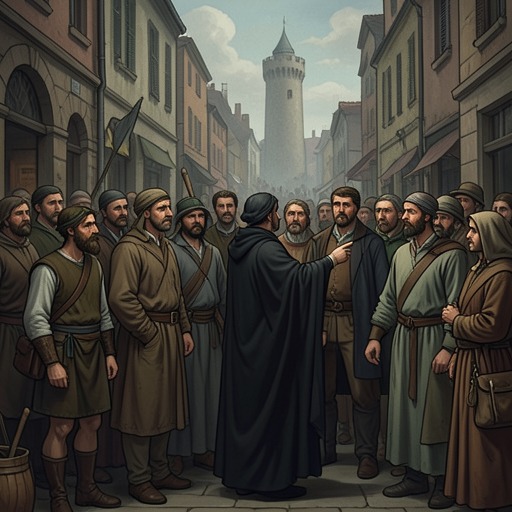
The year belongs to a setting in which Paris is described as three distinct but interdependent towns: the City on the island, the University on the left bank of the Seine, and the Town on the right bank. Their differing identities are reflected in their institutions: churches are concentrated in the City, palaces in the Town, and colleges in the University. The divisions are not merely descriptive; they also organize authority and jurisdiction.
The island is under the bishop, the right bank under the provost of the merchants, and the left bank under the rector, while the provost of Paris exercises royal rather than municipal authority over the whole. The account makes the resulting legal fragmentation concrete: offences by scholars on the left bank are tried on the island and punished on the right bank, subject to the University’s privileges. Those privileges, the narrative observes, had often been secured from kings through revolts and mutinies. This institutional landscape supplies a broad fifteenth-century context for the story, rather than a claim that each jurisdictional practice is specific to 1483.
Law, Privilege, and Refuge
The novel also situates its events within a longer history of asylum. It describes sanctuaries as places where a fugitive could be protected from ordinary punishment, but where safety depended on remaining within the refuge: outside it, the fugitive again faced the reach of the courts and their penalties. The protection was therefore powerful but conditional, and could confine as well as shelter.
A separate date marks the breadth royal authority could give that protection: in 1467, Louis XI made all Paris a place of refuge. The narrative sets this exceptional measure alongside the competing powers of church and state, noting that parliamentary decrees could sometimes override sanctuary, though such interventions were rare. These earlier legal arrangements are not presented as a newly enacted rule of 1483; they form part of the historical background against which the book’s conflicts over judgment, privilege, and safety become legible.
Uneven Endings
The account of 1483 distributes its endings across sharply different kinds of evidence. Louis XI’s death is assigned a month; Gringoire’s achievement survives in an administrative entry; Phoebus’s fate is reduced to the fact that he married. The terse note about Phoebus calls this a tragic end, but offers no further detail about the marriage or its circumstances.
Quasimodo receives no comparable record. He vanished from Notre-Dame on the day Esmeralda and Claude Frollo died, and no one knew what had become of him. The contrast between documented public events and an unresolved private disappearance gives the closing chronology its particular shape: 1483 establishes that the world continues beyond the deaths at the center of the story, but does not make that continuation a complete or consoling resolution.